For our parents, epidemics were common childhood experience

(Published first in OLLI LIFE, newsletter of the Osher Lifelong Learning Institute at Furman University, as the Coronavirus epidemic unfolded in Greenville County, the United States and the world.)

By James T. Hammond

jthammond@restlessboomer.org

Most people living today do not remember past emergency measures such as are in effect now around the world. But for people such as my mother, 95-year-old Callie Hammond, the threat of epidemic diseases was ever present in their childhood.

Callie recalled recently that it was not unusual for schools to close in the 1930s because of the threat of the polio virus. In her youth, millions of people worldwide died or were crippled for life by the poorly understood plague that seemed to revive year after year with the seasons. In 1936, the Greenville County Health Department reported 396 “crippled children,” victims of the polio virus. In 1939, South Carolina experienced 269 cases of polio in the first six months of the year.

Charleston was the hotspot for polio that year. Federal court closed during the summer because of the polio epidemic. Public gatherings were banned. Tourists avoided the state’s beach resorts, causing alarm among state business and political leaders. The Greenville News noted that in 1939, the cause and infection method of polio was a mystery to science. “Polio is one of the biggest question marks facing modern medicine,” the newspaper reported. In 1957, a mass immunization program began, and rapidly reduced the annual infection rate for polio from 58,000 to 5,600 cases.

Today, the World Health Organization estimates there are between 10 million and 20 million survivors of polio alive worldwide, But today, new cases of polio are few. Polio was not the only disease haunting the human race a century ago.

In 1936, an epidemic of malaria broke out in Greenville County. State officials took dramatic steps to attack the mosquito-borne disease. The Greenville News reported that two streams, the Reedy river and Rabun Creek, were extensively dredged to reduce stagnant pools that might host mosquito breeding sites. Some 29 cases of malaria were reported in the county, a rate of infection the newspaper described as “alarming.”

Until the mid-20th century, malaria was an annual threat across the state. In 1929, approximately 40 people were stricken with malaria and state officials rushed to drain swamps and streams where mosquitos bred. In 1928, 13 people died of malaria in Summerton, S.C. In August 1934, a malaria epidemic raged in Camden County, North Carolina, in the region of Albemarle Sound and the Dismal Swamp. The Red Cross sent five nurses from Washington, D.C. to help with the medical response.

In January 1937, the Greenville County Health Department issued a grim review of state efforts to stem viral diseases. The health department administered “prophylactic serums” against a variety of diseases, including 3,445 doses to fight typhoid, 3,297 doses for diphtheria, and 1,923 doses to prevent smallpox. In the late 1930s, smallpox continued to rage, with 23,685 cases in 1927, 38,113 cases in 1928 and 41,459 cases in 1929. In those three years, 442 died of the diseases. Today, nations no longer even vaccinate young people for smallpox, a disease banished from the earth through the most successful public health war on disease in world history.

Perhaps the greatest failure of the public health system came in 1918 with the influenza pandemic. In January 1919. The life insurance industry reported that collectively insurers paid out benefits to beneficiaries of 120,000 policy holders who died of the so-called Spanish Flu. One of the greatest failures to take the pandemic seriously took place in Philadelphia. The flu was known to be in the Philadelphia Navy Yard. The city had planned a war bond parade and rally, and despite sure knowledge of the existence of the flu, went ahead with the parade. It is estimated that 14,500 people died of the flu because the city failed to call off the parade.

This quick review of the art and science of epidemiology shows that collectively we can prevail over disease. It is one of the seminal traits of the human race. But history also shows that when leadership and science falter, we pay a high price in lives and treasure.

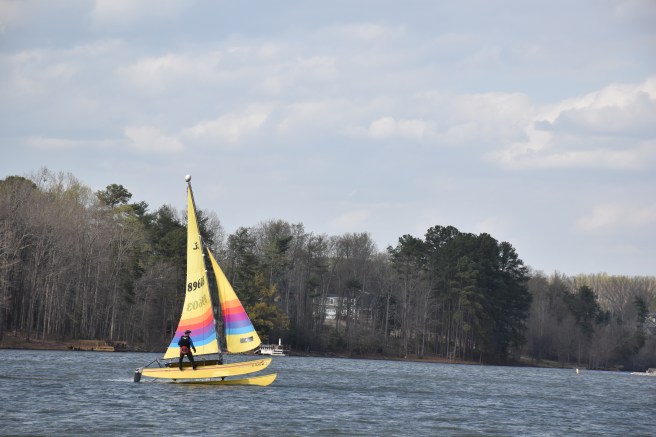
Lake Robinson holds stories of the region’s history

HAM_0013By James T. Hammond

Before it became known as Lake Robinson, named for a former chairman of the Greer Commission of Public Works, the region comprised the free-flowing South Tyger River, thousands of acres of farms, pastures and woodlands, and a naturally occurring pond known as the Devil Catcher.

I grew up here, on the farm of my grandparents, Claude and Clara Belle Barnette. Today, I live on a piece of that farm, preserved in woodlands and meadows that slope gently down to the shore of Barnette Cove. On what is now the Arrowhead subdivision, as a child I would follow Grandpa Claude through the cornfields as he plowed the weeds and grass from the furrows. Walking barefoot behind Grandpa and his mule, I would kick up clods of earth, and look for the arrowheads that even the youngest of us knew were a hidden legacy of people who lived on this land long before our people came here, just after the Revolutionary War.

Until the Cherokee tribes in the region sided with the British at the onset of the rebellion, the state of South Carolina had recognized this land as belonging to the Cherokee. The colonial government even actively discouraged the descendants of Europeans from settling on Cherokee land. The boundary ran roughly where the county line exists today between Greenville and Spartanburg counties, and continues to be memorialized by the name of Line Street in Greer.

Beside the entrance to the Stillwaters community on Groce Meadow Road, there is a small family cemetery that also memorializes the early non-native settlers in the region. William Moon died in 1833, and is buried there with other members of his family. I am a descendant of William Moon’s sister Rachael Moon Glenn. William Moon was born in Virginia and migrated to South Carolina when Cherokee land was seized by the state during punitive raids on their towns in the Blue Ridge foothills. After the Revolutionary War ended, the state began making grants of land to men who had participated in the militias that had fought against British forces.

For much of my life, I had associated the native American history of the region of my youth with the Cherokee. But a significant discovery in the front yard of my grandparents’ home changed that impression forever. In the early 1990s, the Barnette house was vacant for several years, and the grounds around the house largely undisturbed. Grass was sparse in the yard fronting on Groce Meadow Road. The rains had eroded the bare patches of soil, and created tiny pedestals earth holding up small stones. One day, as I walked across the yard, scanning the ground, I notice one stone that was markedly different from the natural stones of the surrounding soil. It was a distinctive triangular shape, its edges expertly crafted to form a point and cutting surface. It was a non-local type of stone known as Chert, widely used by the native peoples to make weapons and tools. It was an arrowhead unlike any I had ever seen in my years kicking up clods behind my Grandpa’s mule.

I immediately assumed it to be Cherokee in origin. But the truth was much more interesting. I took the arrowhead to Chester B. DePratter, Research Professor at the South Carolina Institute of Archaeology and Anthropology, University of South Carolina. This expert on prehistoric people of the Carolinas rolled the arrowhead over in his palm, felt its edges and shape, and declared it to be of truly ancient origin.

The arrowhead was, DePratter said, a Morrow Mountain type of point, possibly as old as 7,000 to 10,000 years old. It dated human habitation of the land of my youth to a time almost unimaginable.

In their book “Greer: From Cotton Town to Industrial Center,” authors Ray Belcher and Joada F. Hiatt provide a more fulsome explanation of what local farmers, souvenir hunters and archeologists have concluded about the early human habitation of the Lake Robinson environs. Belcher and Hiatt describe a plethora of artifacts that have been discovered over many generations that give a sense of how native people used the region. There is little to no evidence of permanent towns or villages. But there is plentiful evidence that those early humans used the South Tyger River basin as camping grounds, working areas to make stone tools and hunting grounds.

At the end of Cove Harbor Court in the Lanford Point subdivision is a cove fed by a small stream that flows during periods of plentiful rain. Before the lake was built, the stream flowed into a naturally occurring swampy pond known as the Devil Catcher.

As the lake was being built and the land cleared by bulldozers, artifact hunters had a rare chance to scour the landscape. Many arrowheads, spear points and stone tools were discovered in the newly uncovered soil. The types included more Morrow Mountain points, likely acquired from people in other regions of the Carolinas. But the artifacts also included arrowheads made from the quartz stone found in the vicinity of the South Tyger River. There was even a location where myriad chips of stone suggested a “stone-knapping” site, where weapons and tools were manufactured.

There is no satisfactory account of how the swamp acquired its name, but in my youth at least, it was a sinister place, home to myriad creatures, most real and some likely imagined. Stories about creatures that lurked in the dense vegetation abounded, and were often told to youngsters to scare them, or keep them from venturing into the abyss.

The Devil Catcher was the source of adventure for young boys of the 1950s and 1960s, and tragedy as well. One sad day in the community involved a neighbor boy in his teens, who was killed in a duck-hunting accident while beaching an old wooden boat at the Devil Catcher. It shook those of us who knew him, and became a cautionary tale about gun safety for many of us.

My Grandpa Claude loved to go fishing at the Devil Catcher and I often went with him. Interconnected wagon roads and trails traversed about a mile distant from Grandpa’s house (which still exists at the corner of Brooke Ann Court and Groce Meadow Road) to the swampy pond. Grandpa was not the only person who frequented the Devil Catcher. A neighbor, John Henery, could often be seen strolling down Grandpa’s driveway, a bamboo fishing pole over his shoulder, headed for the swamp. One day as I passed the hottest part of a summer day on the screened porch with Grandpa Claude, John Henry emerged from the maze of trails carrying by its tail a large snapping turtle. He paused to talk with Grandpa, and declared that dinner for his family that night would be turtle stew.

Some people often used the dense, swampy river and creek drainages to hide illegal activity from the law, mostly in the form of making bootleg whiskey. My Uncle Robert Huff loved to hunt squirrels on my Hammond grandparents’ farm, today known as Hammond Pointe. But in the 1940s and for a couple of decades afterward, the river zone was a great hiding place. Bootleggers would sneak onto the property under the cover of darkness, and set up their illegal liquor stills they cobbled together from steel drums and other found materials. Over the years, Uncle Robert discovered more than one such illicit still on my Grandmother Pauline Hammond’s property. He would dutifully call the sheriff’s office, and deputies would be sent out with guns and axes to destroy the stills and collect evidence. One of my Grandpa Claude’s brothers was a deputy sheriff who sometimes assisted in the enforcement actions, and somehow my Grandpa always seem to have a gallon or two of the clear, powerful and untaxed booze in his pantry.

The most spectacular action against the bootleggers came one night when I was in high school. Sometime during the night, my brother Mike and I were awakened by a tremendous explosion some distance from the house. The next morning the telephone party line lit up with the story of the blast. Bootleggers had built a distilling operation in the very edge of the Devil Catcher. Sheriff’s deputies and revenue agents had been alerted to its existence and were watching as the bootleggers arrived after dark to continue their work. As the lawmen surprised the outlaws, the offenders fled into the Devil Catcher swamp, only to be chased down in the boggy water. The still was one of the largest in the region. Lawmen who usually chopped holes in barrels with axes saw that method as unrealistic. So they set off several sticks of dynamite in the middle of the distillery. The blast that awakened me and my brother flung parts of steel barrels and other debris high into the trees. We visited the site the next day, and saw the debris hanging from the tree limbs. A couple of barrels survived the blast intact, still containing the mixture of water and corn mash fermenting to become alcohol. I approached one of the barrels, peaked over the side, and saw a possum floating in the mash, apparently attracted by the smell of the fermentation and killed when he plunged into the deadly mixture. I continue to wonder to this day if, left uninterrupted, the bootleggers would have simply removed the dead possum and run the fermented liquid through their distiller coils anyway.

The Devil Catcher was the source of many stories that survive today, including the fabled existence of a race of large black cats, panthers, that were rumored to have lived in the swamp. Sometimes people believed they heard the frightening cries of the beast at night. It was a ghost, firmly embedded in local lore, but never seen, killed or captured. A warden on the lake fervently believes he spotted one of the cats in the headlights of his car near his home on Lake Robinson. It is difficult to believe that such a race of panthers could exist without one being killed on the roads by a car, or captured on the ubiquitous game cameras in the wilds today. But it is equally difficult to dislodge the belief that the beasts still roam the lake’s environs.

The shores of the lake have sprouted hundreds of homes since the basin filled in the late 1980s. But a few remnants of the farms that lined the South Tyger River survive. The broad grassy hillside beside the William Few Bridge that crosses the lake is a remnant of the land settled by my third great-grandfather, William Few, in about 1790. He lived on that hill until 1856, when he died at age 85. He is buried in a family cemetery, with other members of his clan. And some of his descendants still own that hillside.

Today, William Few’s view from his hilltop log cabin would be far different, comprising a broad expanse of water in a 950-acre lake with 27 miles of shoreline and 6.5 billion gallons of water capacity. The lake was conceived in the 1970s because the City of Greer’s first reservoir, Lake Cunningham, had become one-third filled with silt from erosion on upstream farmland and sand-mining in the South Tyger River. Today’s conservation measures enforced by the Greer Commission of Public Works aim to prevent a similar destruction of capacity in Lake Robinson.

Lake Robinson has brought a new vitality to this neck of the woods. Many of the new residents know little about the land’s history. But many, upon learning that I was born and grew up here, and have deep family roots in the area, are intensely curious. The Greer Commission of Public Works continues to seek to preserve some of the pastoral character of the lake, by protecting the lakeshore from development. These policies not only preserve the pleasing natural beauty of the space, but also protect the water quality. It is of utmost importance for the people of the Lake Robinson community to support the CPW in its efforts. This does not mean prohibiting people from using and enjoying the lake, but simply enforcing common sense policies to keep the lake safe, protect the environment, and pass it along for future generations to enjoy.


Greenville’s satellite villages getting new look


By James T. Hammond

Pelzer, a former textile mill village, is getting a new look from developers. Just 16 miles from Greenville, on the Anderson County side of the Saluda River, the community prospered with the mill built in 1882. It was the first electrified town in South Carolina, powered by the mill’s turbines.

The river crossing had been known as Wilson’s Ferry. My third Great Grandfather John Wilson owned the land, and represented the district in Congress. He’s buried under the village water tower.

The town has been slow to recover from the mass mill closings of the 20th century. In 1950, Pelzer had a population of 2,692; by 2010 just 89 people lived in the village.

Other Upstate villages have fared better. Growth in Simpsonville is driven by the region’s manufacturing renaissance. Travelers Rest has prospered with the wildly popular Swamp Rabbit Trail. Easley and Pickens want to reproduce that model by converting a rail line into a recreational trail.

When I left Greenville in 1979, Main Street was a hallow shell. Retailers including Belk and J.C. Penney moved to suburban malls. Furman University left a gaping hole in the heart of the city with its move to the suburbs. But visionaries were working to breathe new life into the small southern town that once touted itself as the Textile Capital of the World.

What a difference 40 years has made. We are entering a third generation of civic leaders who daily have made it their mission to made Greenville’s urban core a place where people want to live, work, play, and raise families.

Greenville County’s population in 2010 was 451,225, according to the U.S. Census. By 2015, that number was estimated to have grown to 474,903, and to 498,766 in 2016.

Local officials estimate that on average 22 people moved to Greenville County daily in 2016. The city is getting about 11 of those new residents per day. The Greenville News reported that the 5.8% growth rate makes the city the fourth fastest growing in the nation.

My life choice is that, on balance, change is good. You who read this are part of this change. The Greenville I find today is infinitely better than the city I left in 1979. How about you? Are you happy with this rapidly evolving place we call home?


OLLI weaves Furman’s ties to Greenville

Published in OLLILIFE, 2018


By James T. Hammond

For more than a century, Furman University anchored downtown Greenville, growing to cover a vast area still known as University Ridge. But when the university broke ground in 1953 for a new campus north of the city on 750 acres, many saw the move as abandonment of the city.

Former President David Shi told me once that when he first came to Furman as a student, the college gave him directions to avoid passing through downtown Greenville.

Not only did the move leave a large void on University Ridge; the consolidation with Greenville Women’s College took away another institution of higher learning on College Street.

But Furman has come a long way in its community outreach in 65 years since its move to the country. The relocation provided room to expand, growth impossible at the downtown location. And the university’s institutions have become more outwardly focused since it declared its independence from the South Carolina Baptist Convention in 1992.

About that time, a small group of Furman faculty, alumni and other Greenville citizens were organizing the Furman University Learning in Retirement program. In 1993, it offered seven classes to 62 members, operating in one classroom in Furman Hall under founder and Director Sarah Fletcher.

As then President David Shi began to realize the potential of the program to bind Furman to the community, a string of milestones followed.

In 2008, FULIR received the first installment of what would grow to a $1 million endowment from the Bernard Osher Foundation, securing operational funding for the program’s future. In 2009, membership reached 500 and FULIR became the Osher Lifelong Learning Institute at Furman, or OLLI.

As enrollment in OLLI soared, the leadership faced the realization that the program would need more, preferably its own, space. A $6 million, 22,000 square foot facility was conceived. As, membership climbed to 1,100, OLLI members raised $3 million. Several major gifts followed, including a “significant gift” from Furman trustee Gordon Herring that earned him naming rights for the new Herring Center.

Since 2012, when OLLI moved into its new home, membership more than doubled, to 2,350 from 1,200.

“There may be a day when we have more OLLI members than Furman students,” said OLLI Director Nancy Kennedy, who took over direction of the OLLI program from Lucy Woodhouse in 2014. “It is very important for Furman to have a presence in the community.”

This year is the 25th anniversary of the founding of FULIR, now OLLI. A 2016 survey of members showed a profile of a geographically diverse group: 46 percent of members had moved here within the past 9 years.

Some 60 percent of members are women. Ages of participants range 55-101; the largest cohort being 55-74.

Just 4 percent of members are minorities, and Kennedy added, “We’re working on that,” with presentations to groups with large minorities memberships.

The new building had a major impact on membership growth, Kennedy said, with improved parking, space for more and larger classes, and increased social opportunities such as card games and special interest groups.

“Members are proud to have their own place,” Kennedy said.

Motives vary for joining OLLI. Aside from the myriad classes, “Some people join for bonus events, some to play bridge, and some just to go to the dining hall,” she said. “And that’s all good.

“We’ve had some romances start here,” Kennedy said with a smile, “But I don’t think we’ve had anyone meet and marry here.”


Gettting to South Carolina’s high places

First published in OLLILIFE, January 2019

By James T. Hammond

I like high places.

Living in Greenville County, it’s easy to get to the highest places in our state. Recently, my brother Mike and I drove 45 minutes to get to the highest place in South Carolina, the peak of Sassafras Mountain in Pickens County. The state Department of Natural Resources is building an observation tower there and the view is spectacular. One can see the lakes that flood the mountain valleys of the Carolina Foothills.

Recently the state Department of Natural Resources installed permanent toilets, and a landscaped trail has been built from the parking lot to the peak. We enjoyed hanging out at the peak and surveying the surrounding mountains for 40 miles around. An observation desk that opened this spring improves the panoramic view from the peak.

To reach Sassafras Mountain peak, take Scenic Highway 11, passing Table Rock State Park, to US178. Turn right, traveling toward Rosman and Brevard. At Rocky Bottom, turn right on the F. Van Clayton Memorial Highway and drive until it ends at the peak.

Here are a few of my other favorite places, off the beaten path, within an hour of downtown Greenville.

Little Texas Grocery Is on State Park Road a short drive from US25. The small frame building that was a country store in my youth is now a hot dog stand that also sells Mike & Jeff’s Barbeque. You can also get a soft drink – my favorite is Cheerwine – in a glass bottle, just like the old days. And if you have car trouble, you can also get help. The owner operates a towing service from the location.

Overmountain Vineyard, 70 acres of wine grapes and winery, sits astride the Overmountain Victory National Historic Trail, which traces the route trod by rebel militia during the Kings Mountain campaign of 1780. Frank and LIta Lilly took the first steps toward building their dream almost 30 years ago. Today it rests in the middle of horse country near the Tryon International Equestrian Center. Buy a bottle of OMV wine, or a tasting several of their wines, and enjoy their spectacular veranda. Reach OMV from I-26, at 2012 Sandy Plains Road, Tryon, N.C.

Cedar Falls Park is where you’ll find the other Reedy River falls. The county park is at the site of a magnificent cataract and the brick and concrete remnants of a textile mill. 201 Cedar Falls Rd, Fountain Inn

Lake Conestee Nature Park comprises 400 acres of forest and trails, and three miles of the Reedy River. Citizens organized a non-profit to restore the former industrial area and maintain a polluted mill pond. Today it is home to diverse wildlife, including a Great Blue Heron rookery. Main entrance is at 840 Mauldin Road.

Trade Street in Greer retains much of the century-old charm I knew in my youth, and has become a new entertainment and small business destination. Discover its rich and growing foodie culture.

Lake Robinson Park is the public access area for the 900-acre gem of the Greer Commission of Public Works water system. Area fishermen know it well as the launching point for their boats. It also offers an opportunity for non-boaters to picnic and enjoy one of the best views of the Blue Ridge escarpment in the county. From Greer, drive north on SC101, turn left on Milford Church Road, and right on Groce Meadow Road, to the intersection with Mays Bridge Road.

Fisher’s Peach and Vegetable Market was started by my high school friend, the late Tommy Fischer. His family carries on the tradition at the historic Taylors Peach Shed on Locust Hill Road, and at the former Dillard’s Peach Shed on South Buncombe Road in Greer.

Saluda, N.C., nestled in the first folds of the Blue Ridge Mountains, and just off I-26, features a good café, The Purple Cow, a railroad museum, and a couple of interesting old general stories with themes of times gone by.

The town of Landrum, in Spartanburg County, which fell on hard times after its textile mill closed, is back and attracting a lot of attention. Reached by I-26 or US-14, it is a cornucopia of antique and other shops and restaurants.


S.C. industry deserves state energy strategy to protect public health, jobs

By James T. Hammond

South Carolina boasts one of the nation’s most vibrant industrial sectors, including being the largest exporter of cars and tires among the 50 states. A growing manufacturing economy provides tens of thousands of well-paying jobs across the state.

But that strength and momentum could grind to a halt if the state’s supply of plentiful and cost-effective electricity were threatened, as it has been in recent weeks as South Carolina Electric and Gas and its partner, state-owned utility Santee Cooper, announced they would abandon construction of two new nuclear reactors in Fairfield County.

That thunderbolt has shaken the state’s leadership, cost the CEOs of Santee Cooper and SCANA their jobs. SCANA is the parent company of SCE&G. The shocking development also has sent Gov. Henry McMaster into crisis mode, seeking new investors to restart the V.C. Summer project, in hopes of finishing at least one of the two planned reactors; and possibly the sale of Santee Cooper to private investors.

It is easy to believe that McMaster is driven more by ideological free-market notions than by what is good for South Carolina in the long term. Santee Cooper has been and should continue to be the bedrock upon which the state’s network of electric cooperatives is built.

The electric energy industry has been in tumult in recent years, as federal regulations have forced the shutdown of coal-fired energy plants. SCE&G announced in 2012 that it would shut down six coal-fired plants by the end of 2018. Those have been replaced in the short-term relatively easily with natural gas units, as plentiful new sources have driven down the cost of that cleaner burning fuel. But it is unclear how long those supplies and low prices will continue.

Utilities including SCE&G have made major commitments to solar generated electricity. But solar and wind sources currently represent less than five percent of South Carolina’s supply of electricity. Barring major innovations in technology, renewable sources show scant potential to replace so-called “base load” energy generated by nuclear and coal. A traditional source of renewable energy supply, hydroelectric stations on our streams and rivers, is about maxed out in terms of potential for new supply. And a growing population will compete with the power companies for the water that drives turbines to generate electricity.

Many states will need to have this conversation in the years ahead, but South Carolina is uniquely dependent upon nuclear power. Today, some 57% of South Carolina’s electric supply comes from nuclear sources. There are:

  • Three reactors at Oconee Nuclear Station near Seneca;
  • Two reactors at Catawba Nuclear Station in York County;
  • One reactor at V.C. Summer Station in Fairfield County;
  • And one reactor at the Robinson Station in Darlington County.

All are decades old and some likely will be shut down due to age in current residents’ lifetimes.

Duke Energy sought the cover of the angst focused upon the SCE&G/Santee Cooper decision to float out the news that it, too, would abandon plans for a new reactor near Gaffney, South Carolina. Duke is only out some $542 million in planning and pre-construction costs, but the decision does not bode well for power supplies in the Carolinas.

The two new reactors in Fairfield County were planned to replace aging facilities and maintain ample reserves of electricity for a growing economy and population in one of the fasting growing states in the nation. With billions of dollars already spent on the V.C. Summer project, it remains unclear whether a white knight will surface to resume construction of one or more of the unfinished nuclear reactors. Despite its great cost and uncertain health consequences, nuclear remains the best solution to prevent further spoiling of the atmosphere with noxious emissions.

Meanwhile, coal should remain off the table for future electricity production. Despite decades of work to reduce toxic emissions from the smokestacks of coal plants, the Clean Energy Task Force estimated that coal’s polluting impact was responsible for some 7,500 deaths nationwide annually in a 2014 report. The known health risks of burning coal are too high to justify its future use in the power industry.

So with coal continuing to diminish in electricity production and the region’s nuclear plants inevitably aging out, it is imperative that Gov. McMaster, the General Assembly and the state’s industrial leaders convene a task force to study the state’s future energy needs, coupled with the public health issues associated with every source. Current law has set a tiny goal of just 2% of total power generation from renewable sources by 2021.

South Carolina desperately needs a comprehensive policy that addresses the seismic shift in the energy landscape with the abandonment of the two nuclear plants. Let’s not wait for the lights to dim and the factories to close because the electricity supply has become too expensive and unreliable.

James T. Hammond is a retired journalist living in the Carolina foothills of Greenville County.

Xenophobia is bad for business

(Previously published in the Columbia Regional Business Report)

By James T. Hammond

“Give me your tired, your poor,

 Your huddled masses, yearning to breath free,

 The wretched refuse of your teeming shore,

 Send these, the homeless, tempest tost to me,

 I lift my lamp beside the golden door.”

The verse by Emma Lazarus, inscribed on the Statue of Liberty, sounds a little hollow these days, and the lamp dimmed, with our governor and both our U.S. Senators clamoring to close the door to the tragic victims of the war in the Eastern Mediterranean. The welcome light seems especially dimmed with the daughter of immigrants, Nikki Haley, trying to snuff it out.

It is worth noting that the Democrat who opposed Haley for election twice, Sen. Vincent Sheheen, is the grandson of Syrian immigrants. Syrian/Lebanese descendants are almost too numerous to count in the Carolinas, including a former speaker of the House, former members of the state Senate, and numerous business leaders and owners.

It’s always been tough for people who are “different” to find acceptance on the shores of America. But millions have tried and made it, spawning new generations of loyal and productive Americans.

For decades, Congress sought to exclude Chinese immigrants from settling here. What fantastic Americans they have become. Irish flooding into New York were despised by many who arrived earlier. Japanese Americans, many born in this country, were imprisoned during World War II. And many of those joined the U.S. Army to prove their loyalty to this land.

In 1904, Lutfallah Jarjoura Saad left his homeland in the Mt. Lebanon region of Syria with two other young men. They probably boarded a ship bounded for Southern France, and traveled overland to the channel port of Le Havre. We know they traveled by ocean liner to the Canadian port of Quebec, where they boarded a train bound for the United States. Their path is witnessed by the ocean liner’s passenger list and a border crossing document when their train crossed into the United States. He was 19 years old and had $22 when he arrived in the United States of America.

They joined thousands of other Syrian immigrants to work in a shoe factory in Lawrence, Mass. Lutfallah married another Syrian immigrant, Rosa; they relocated to the small North Carolina town of Selma; they had a large family and almost two dozen grandchildren. Among them are a police officer, a State Department Foreign Service officer, a school teacher, a high-tech computer industry entrepreneur and several journalists. I married one of those journalists. One of Lutfallah’s great-grandchildren today is a cadet at the U.S. Air Force Academy.

Others among the Saad descendants served in the American armed forces; worked as a civilian working with the U.S. Army Corps of Engineers; became small town business owners; worked in home construction; and directed of a homeless rehabilitation center. Great-grandchildren include a lawyer, more journalists, a playwright, a parks administrator, a city councilman, two musicians, a teacher, a banker.

If Lutfallah had not been allowed to settle in this country, I would not have the family whom I cherish. Lutfallah was typical of thousands of Syrians who came to this country seeking a better life. He may also have come to escape conscription into the army of the ruling Ottoman Empire, which ruled that region in 1904. Lebanon had not yet been carved out as a separate country, and today many of the descendants of these self-identifying Syrians called themselves Lebanese Americans. Or maybe just Americans.

If Syrians had not been allowed into this country in 1954, the father of Steve Jobs may have been excluded, and there might never have been the Apple Computer Co.

We all know people whose grandparents came to this country from the eastern Mediterranean to ensure the fruits of America for their children.

People who agree with Emma Lazarus that we should welcome people fleeing persecution or looking for a better life on these shores need to speak up against the gathering darkness so evident in our times. While it is reasonable to expect our government to carefully screen people seeking to enter our country, we must raise our voice against intolerance and exclusion.

Creating a process in which people longing to be free and safe can come to America is more than just a moral imperative. The absence of such a policy is in effect criminalizing large sectors of our economy. One of the hardest hit by the failure of Congress to deal with the immigration issue is agriculture.

Farmers today struggle to find people who will work in the fields, to harvest and process the food that ends up on our tables. Because most South Carolinians today will not do the work, the farmers turn to contractors who bring in immigrant labor. And because there is no legal path for many of those workers to obtain proper documents to work here, those contractors turn a blind eye to undocumented people who yearn to work in these essential farming activities.

It is tragic that so many otherwise respectable farming family enterprises have essentially been criminalized by the failure of Congress to act.

Our current legal immigrant admissions process is more than rigorous. I accept that there must be a high bar for admission to our country in difficult times such as these. But it should not be impossible.

James T. Hammond can be reached by email at jthammond46@gmail.com.


After the deluge: South Carolina gets lesson in federalism

 Published December 8, 2015

South Carolina’s Republican congressmen and two senators received a well-deserved lesson in the value of being part of a large nation that can bring financial muscle to bear on disasters that can wreck the economy of any state left to its own resources.

These men elected to help run the nation as well as represent the state voted against the rescue legislation for New York and New Jersey in the wake of Hurricane Sandy in 2012, grousing peevishly that too much of the money in the bill was going to states not impacted by the storm.

Now, since an early October storm visited floods and the state’s greatest modern disaster on South Carolina, these same men are pledging that they’ll get whatever is needed from Congress to repair the state’s soggy, flood-ravaged landscape.

“Whatever it costs, it costs,” U.S. Sen. Lindsey Graham told CNN.

Perhaps these ideologues will be more compassionate toward future needs in other states. We can only hope that members of Congress do not punish the stricken citizens of South Carolina for the lack of empathy displayed by their representatives toward New York and New Jersey.

The need in South Carolina is great. By Monday, Dec. 7, 2015, some 24,489 applications for FEMA assistance already had been approved for assistance totaling more than $71 million. Some $15 million is providing public sectors assistance. Those numbers will grow significantly as more and more affected people have a chance to apply for assistance.

A broad swath of South Carolina has been laid waste, including farmers’ crops, people’s homes, commercial businesses, and the state’s already under-maintained transportation system. We desperately need the help of the nation, much as Louisiana needed assistance after Hurricane Katrina and the Atlantic states needed a helping hand after Hurricane Sandy.

Fortunately, the Obama administration has moved quickly to marshal federal resources in support of South Carolina. The Federal Emergency Management Agency, a unit of the U.S. Department of Homeland Security, already is setting up field offices in the state. The Secretary of Homeland Security, Jeh Johnson, was in South Carolina talking to officials and surveying the damage within days of the flood. FEMA has about $6 billion available in its disaster fund already, but a special appropriation is expected to ensure that South Carolina’s disaster relief needs are met.

Sen. Graham and other S.C. representatives have pledged to submit such a special bill to Congress.

Meanwhile, substantial federal resources have been hard at work since the first sign that the region would experience unprecedented floods from 26 inches of rain that fell across the Midlands. The South Carolina National Guard, largely funded by Congress, has deployed its people and machines to rescue stranded residents from flooded homes and to help civil officials with emergencies such as the breach in the Columbia canal, where the city gets most of its water supply.

As FEMA representatives fan out across the region, checks will be written to help desperate people with short- and long-term housing needs, and to begin repairs on their damaged homes. People who did not have flood insurance can receive grants up to $33,000 to begin repairs on their houses. The grants have strings of course, but not unreasonable ones. Recipients of the grants will be required to sign up for flood insurance to protect them against future flooding.

Federal law also provides other measures to help flooded citizens get back on their feet.

Walda Wildman, a Columbia CPA, notes that citizens with significant uninsured losses in the flood may benefit from a provision in the tax code that allows those living in federally designated disaster areas to amend their prior year’s return to deduct those losses. The provision means a taxpayer can amend his or her 2014 return and won’t have to wait to file a 2015 return to “benefit” from the deduction. Like the rest of the tax code, this is not necessarily simple, so everyone impacted should seek tax advice about the benefit and how to file the required forms.

Amending 2014 applies only to 1040s, Wildman said.  Some 1040s do, however, report income from businesses so it is worth consulting a tax advisor regarding the specifics of the situation.

“My concern is only to get the word out so that those affected will know their options.  This is complex.  IRS Publication 547, Casualties, Disasters, and Thefts, covers the rules,” Wildman said.

The federal Small Business Administration also will be a player, offering loans to flood-damaged individuals and businesses.

Businesses and private nonprofit organizations may borrow up to $2 million to repair or replace damaged or destroyed real estate, machinery and equipment, inventory, and other business assets.  The SBA may increase a loan up to 20% of the disaster damage to real estate and/or leasehold improvements, to make improvements that lessen the risk of property damage by future disasters.

The private sector also has stepped up to assist flood-stricken South Carolina: BlueCross BlueShield of South Carolina has donated $1 million for flood relief; Wells Fargo, $300,000; Boeing, $100,000; and AT&T, $50,000. More private money will follow.

And South Carolina lawmakers, particularly those who represent the Midlands, are talking about a special session of the General Assembly to take up a flood relief appropriation bill. Reps. James Smith and Rick Quinn, a truly bipartisan team, are proposing various measures to provide the state’s share of disaster relief, including a bond bill and use of surplus funds. A bond bill makes sense; interest rates remain at all-time lows, and borrowing the money would be the quickest way to restore damaged infrastructure.

The Republican dominated General Assembly and Gov. Nikki Haley have blocked efforts to use debt as one of state government’s tools to meet the people’s needs, but there is a time and a place for everything. It is time for these officials to lead, and to provide the vital resources to restore South Carolina flood-ravaged structures by whatever means necessary.

Shared responsibility and shared sacrifice are good virtues, in personal relationships as well and government commitments. South Carolina benefits daily from its membership in the United States of America. This state’s representatives in Congress need to remember that when called upon to help others as well as during this great crisis brought by historic flooding across the region.

Reach James T. Hammond by e-mail at jthammond46(AT)gmail.com.


S.C. Utilities, conservation groups agree on solar net metering

Duke Energy and South Carolina Electric & Gas Co. said today they support an agreement with the Public Service Commission of South Carolina that outlines a balanced path for solar net metering in the state.

Conservation groups echoed the enthusiasm for the agreement.

“This is a great deal,” said Blan Holman, managing attorney for the Southern Environmental Law Center.

Read the full story here in the Columbia Regional Business Report

Starting the next chapter

Wrapping up a 45-year career in print journalism has been a time for reflection. The daily newspapers that have employed me are in transition to multi-media news and information outlets. Information travels at the speed of light. The new technology can be thrilling. For example, I do not miss the smelly darkrooms and noxious chemicals required to process photographs when I started in the business in the 1960s. Give me a state-of-the-art digital camera any day.

Turning off interest in the news of our community, or state and the world is difficult, if not impossible. And I may have the urge to write now and then. So stay tuned…